
Synchronicity
synchronicity
Pronunciation: (sĭng'krə-nĭs'ĭ-tē, sĭn'-)
Function: noun
1. The state or fact of being synchronous or simultaneous; synchronism.
2. Coincidence of events that seem to be meaningfully related, conceived in Jungian theory as an explanatory principle on the same order as causality.
Okay, true story: Several years ago I was out with a guy I was dating at the time. For some reason, we began to have a discussion about the word "synchronicity." About an hour later, we heard the song "Synchronicity" by the Police being played. So, I guess you could call that a synchronicity synchronicity… But, seriously, this has always been one of my favorite words, perhaps because I experience this Jungian principle so damn often. I'm sure everyone has experienced it, too: maybe during one week you hear a word you've never heard a number of times. Or, you find that several people have recommended the same book to you. Here's a rule of thumb I've come up with: once you've had a three-time synchronicity, it's time to pay attention. But then, I don't happen to believe in coincidence…
Thanks to Constant Comment for today's WOTD entry
Thursday, July 31, 2008
Word of the Day
Bob's CCCW*, Chapter 3
See the previous Chapters here and here. And it's not too late to contribute for this week's chapter over at my place!
Teresa was on her way to Las Vegas, having gotten a tip that Bill and Jerry had been spotted at the Luxor, when her cell phone rang.
"Hello?"
"Hi, Teresa, it's Lynne," came the response. "I've got good news for you. We've decided to push up the release date of your book to next week."
Teresa had been waiting months to hear this news, but was, for the moment, confused - her mind was so focused on getting to Vegas before Bill left town.
"I'm sorry?" she asked. "Book? ... Oh! Why, that's great!"
"I thought you'd be happy," Lynne replied. "But I need you to be in New York this afternoon. We've booked you on Regis & Kelly to talk about it. There's a ticket waiting at the airport for you. Oh, and make sure you pack a green outfit."
Why was green so very important? She had no idea. But that really wasn't a concern right now. "Ummm, I'm not at home. I'm on I-40 between Flagstaff and Kingman, on my way to Vegas." She hesitated, not wanting to say why she was on her way to Vegas. Somehow, she didn't think that telling her editor that she was on her way to kill her ex would be a career plus.
"Vegas? Okay,... we can get you a ticket on the red-eye into New York, and I'll get someone to pick up an outfit for you." Lynne said. "Postpone your gambling and head to the airport. I'll have a driver waiting at Newark, to take you to your hotel. See you in the morning!" ... and she hung up.
Shit. Shit, shit, shit... Teresa thought as she dropped the cell phone on the seat beside her....
Meanwhile, in Vegas............
Bill awoke from a deep sleep and looked around the room. Luckily, Jerry was not there. Breathing a sigh of relief, Bill let go of the closed umbrella he had been clutching when he finally drifted off to sleep, got up from the bed, and headed for the bathroom.
Bill wasn't sure what had been going on with Jerry the night before. He'd been perfectly content to let the laundry pile up in the corner. That is, until the pile started talking to him. Bill suspected it had something to do with the 300 pound Samoan he had seen talking to Jerry in the casino earlier. Something wasn't quite right about the guy - flailing his arms about like he was swatting at giant flies and all that.
As he stepped under the stream of hot water in the shower, he thought again about trying to call Teresa and seeing if he could explain. By the time he finished showering, he knew exactly what he would say to her ... if she answered the phone.
He reached for the towel and his hand closed on something unexpected. What was this? A second umbrella?...
Later that morning, in the Green Room of the Regis & Kelly show.......
Teresa finished off her fourth cup of coffee since awakening, confused, in her hotel room. She really needed to pee, but had been cornered by Regis, who was telling stories of his childhood, and Kelly - who was being very ... Kelly.
As Regis finished a story about how his mom did his nail polish the first time he cross-dressed, Teresa looked around desperately, hoping to catch Lynne's attention. Unfortunately, Lynne had left the room with one of the other guests, to do what Teresa didn't know. As Regis paused in his torrent of tales of his youth, Kelly piped up with a series of questions. When the host asked how A Wizard of Earthsea was different than Harry Potter, she sat stunned for a moment and then realized, she was in the presence of stupid people with no knowledge of classical fantasy.
Teresa stood up abruptly and she cried, "No more, no more" and ran out of the room. She ran down the hall and out to the street, where she stood stunned. It was raining, but it wasn't water falling from the sky. She started shaking her head in denial as she stared at the scene in front of her. It had been years since she had seen that many frogs in one place....
Back in Vegas............
Bill hurried down the hall of the luxury hotel, buttoning his shirt with one hand, and trying not to drop his shoes as he rushed for the elevator. Something was very wrong. He jabbed at the "G" repeatedly, hoping - as people in a hurry always do - that it would somehow speed up the process of the elevator doors closing and the car getting to its destination.
The elevator performed its duties in at its own pace, however, but eventually (to Bill's frantic thinking) opened the doors and let him out in the lobby. He ran past the slot machines and out the door, planning on grabbing the first taxi in line to get him the hell away from whatever was happening back in the room that he and Jerry had been sharing.
As the heat of a Las Vegas day hit him, he skidded to a halt, confused. There were no taxis or shuttle buses under the canopy. There was no valet, waiting for the next guest to arrive. There were no people visible anywhere. It was just too damn quiet outside....
____________
He looked up from the unfinished manuscript and around the nearly empty room. This was just one of many partial stories that Arianne had left behind when she abruptly closed her bakery and left town, and he had finally gotten around to putting them into storage. He couldn't bring himself to throw them away, hoping that she would someday return. Guy sighed again as he looked around the large apartment that Arianne and he had called home for the short time they were together.
The bells in the cathedral tolled 8, but it was only 3:45 as he reached over to get another box into which to put the stories and the other remainders of their relationship, and noticed that the boxes, once seemingly an endless pile, had suddenly run out. There was no container for the most precious of their belongings.
Then he noticed the TCU umbrella in the corner....
*Creatively Created Creative Writing
my plan b
to say, well, an egg only sticks around
for 12 to 24 hours
and we didn't fuck until 36 hours after
i felt the telltale cramps of ovulation
my plan b is to pretend that
a 30-minute bike ride, still tender-cunted
over jostling new orleans streets
in heady, heavy heat
to a shuttered planned parenthood is
just another saturday morning
my plan b is to fog out the memory
of the moment i relented
after the first condom came off
that wasn't replaced
my plan b is to pretend i wasn't on top,
that it wasn't my hand that guided you
my plan b is to blame myself
my plan b is to tell you to bring more condoms
my plan b is to put faith in pulling out
my plan b is to wonder how you seem to actually fuck my brains out
my plan b is to write this poem
my plan b was dispensed quietly
by a pharmacist named rhonda
she had soft brown eyes and soft brown hands
and i wanted her to take her hand and put it on mine
give it a gentle rub, and a maternal squeeze
instead she just told me it would be $47.95
i thanked her without looking her in the eye
Submitted by Cate Root
About the Author:
Cate Root is a sugar-tongued radical feminist word cunt, holding it down in 5th Ward New Orleans. She can be reached at nolariffic(at)gmail(dot)com or peep her out at www.myspace.com/pfunkem.
Wednesday, July 30, 2008
Word of the Day
Miasma
Pronunciation: \mī-ˈaz-mə, mē-\
Function: noun
Inflected Form(s): plural mi•as•mas also mi•as•ma•ta
Etymology: New Latin, from Greek, defilement, from miainein to pollute
Date: 1665
A poisonous vapor or mist believed to be made up of particles from decomposing material that could cause disease and could be identified by its foul smell. The miasma theory of disease originated in the Middle Ages and persisted for centuries. During the Great Plague of 1665, doctors wore masks filled with sweet-smelling flowers to keep out the poisonous miasmas. Because of the miasmas, they sanitized some buildings, required that night soil be removed from public proximity and had swamps drained to get rid of the bad smells. However, the miasmic approach only worked if something smelled bad. In the winter, sanitation was forgotten.
Miasmic reasoning prevented many doctors from adopting new practices like washing their hands between patients. Lethal agents traveled by air, they thought, not lodged beneath a doctor's fingernail. Although the miasma theory proved incorrect, it represented some recognition of the relation between dirtiness and disease. It encouraged cleanliness and paved the way for public health reform. The pioneer nurse Florence Nightingale (1820-1910) firmly believed in miasmas and became celebrated for her work in making hospitals clean, fresh and airy. The miasma theory also helped interest scientists in decaying matter and led eventually to the identification of microbes as agents of infectious disease.
To this day, the misinformed notion that dead bodies cause disease leads to millions of wasted dollars and energy in areas hit by disasters, attempting to quickly bury or disinfect the dead.
Common current usage includes: an influence or atmosphere that tends to deplete or corrupt also : an atmosphere that obscures (fog)
"The presidential campaign has already become a money miasma, a runaway race to break all fund-raising records. All manner of dodgy election initiatives have been concocted."
— NY Times, (8/7/08)
Thanks to Faith for today's WOTD entry
Bob's Creatively Created Creative Writing (Still Catching Y'all Up)
Chapter 2 in the ongoing story in which I weave reader submitted quotes into a somewhat coherent narrative (Chapter 1 here). Apologies to Garrison Keillor and the ghost of Hunter S. Thompson, but that's where the submitted comments led me that week, folks.
Remember, starting next Tuesday I'll be begging asking for snippets for the newest chapter, which I will be writing on the following Sunday. And, if you can't wait to play, you can visit my place and get a comment in for this week's chapter!!
It was a dark night in the city in the mountains. I had been hitting the bottle pretty hard at the Five Spot, my favorite watering hole. I dragged my bleary eyes up towards the clock behind the bar. At first, the clock on the wall read half passed[sic] a monkey's ass, a quarter 'til his balls, but after I rubbed my eyes, I realized that I was still mildly drunk and the clock really read 1:17a.m. Okay, I was more than mildly drunk. I was well on my way to being plastered... or beyond.
Jimmy wasn't there that night, and Ellen, the substitute bartender, could see the mood I was in and was setting down a fresh drink for me before I could even ask.
The rain was coming down outside like the flow of Niagara over the falls, and the frequent lightning showed the deserted late night streets of the "metropolis" of AsheVegas. Even the cabbies were laying low.
I told Ellen to not make me any more drinks, as I had an early appointment the next morning with a potential client. It was a simple check on a business partner who was thought to be skimming profits, but it promised to pay well - and I needed the bucks, as the rent on my office was past due.
All of us left in the bar turned to look as lightning struck a lamppost outside, the thunder loud enough to rattle the bottles of premium liquor on the top shelf behind the bar. The sound of the thunder echoed off the buildings of the city as I put on my raincoat and fedora.
Ellen asked me if I wanted her to call me a cab, but I told her the walk back to the office would be good for me - and that I was a private investigator, not a mode of transportation. As I stood there, wobbling slightly due to the alcohol and waiting in vain for her to laugh at my joke, I noticed it was silent outside. The rumble had subsided and I went outside at last.
I turned right to head down the street toward my office and the rumpled sofa I called my bed, and there she was. Tall and slim, with her long, curly red hair plastered to her head from the rain, she was wearing a white raincoat that looked like the repellent had worn out long ago. She was barefoot, and carrying one high-heeled shoe in her porcelain-skinned, long-fingered hand.
"Excuse me, sir," she said in a throaty voice that would warm an Iditarod racer who had been on the go all day in a blizzard. Do you know the famous detective, Guy Noir? The doorman at his building said he hangs out in the bar you just left."
"I not only know him, I am him," I replied.
"Wow," she said. "That's some kind of coincidence."
"I'm in no position to believe in coincidence." She grabbed hold of me as another bolt of lightning struck nearby, wrapping her slim arms around my neck and holding on tight. I could feel her heart beating against my chest as she sobbed quietly.
She looked at me sheepishly as she released me and said, "I'm sorry, Mr. Noir. I'm a bit afraid of thunderstorms. I didn't hurt you, did I?"
"My neck hurts," I replied, still feeling the warmth of her being pressed against me, "but that's an old injury and not your fault. Why don't we go to my office and out of this storm, and you can tell me why you were looking for me?"
A part of me hoped another lightning bolt would cause her to grab hold of me again, as it had been some time since a beautiful woman had been that close to me, but we made it to the Acme Building without any of them. We went up the elevator to my floor and into my office. I went into my bathroom to get her a towel so she could dry her hair and face, and when I came back out I stood stunned for a moment.
She had taken off her raincoat, and stood there wearing a rain-soaked peasant blouse and a skirt so short I could see the bottom of the word "Saturday" embroidered on the back of her panties.
I handed her the towel and went to the closet to get her one of my spare shirts.
"Here," I said, handing her the shirt, "you can go into the bathroom and put this on. We can hang your blouse over the radiator to dry."
Her pale face turned red as she looked down at her blouse that was stuck to her like a second skin. "Thank you. I'm not leaving much to the imagination right now, am I?"
"I don't mind," I said quietly to her back as she walked into the bathroom and closed the door.
When she came out of the bathroom and laid her blouse and skirt on the top of the radiator, she told me why she had been looking for me. Her name was Arianne Campbell. She owned a small bake shop and cafe on the other side of town, and was having problems with the lawyer's office next door. There were all sorts of loud and strange noises coming from over there all day long, and it was scaring her patrons off.
While she told her story, I stood at the window watching the rain fall. I had heard of the shop she owned. It was one of those sketchy places, but the food was great. I had never been there myself, as I was the type that preferred street vendor hot dogs to gluten-free carob chip muffins.
When she fell silent, I turned to tell her my standard rates and saw that she had fallen asleep on the sofa. I sighed, pulled my tattered blanket over her, and sat down at my desk. I put my feet up on the desk and settled back to nap a bit myself, somewhat glad that we didn't negotiate my fee while I was drunk. That had never worked out well for me in the past....
The sound of the garbage truck backing into the alley outside my window woke me. The sun was low on the eastern horizon and just beginning to send its golden rays into my office. I looked over at the sofa and wasn't surprised to see it empty. I brewed a pot of coffee and washed my face, then decided, since my appointment wasn't for another two hours, to head over to her place - make sure she was okay and to return her clothes that she had left on the now cold radiator.
As the cab pulled up to her address, I could see her standing on the sidewalk in front of her shop. She sighed as she watched the hand-painted sign flapping loosely above her little bakery: 'Pie Dough and Trends'. Once, it had been the favorite haunt of the "in" crowd. Now, she was in jeopardy of losing it.
"Good morning, Miss Campbell," I said as I stepped up beside her and held out her blouse and skirt. "You left these at my office."
She flashed a brilliant smile at me and said "I hope I didn't wake you when I left. I needed to get over here and open up ... in case anyone shows up wanting food, that is." Her large blue eyes began welling with tears as she turned and unlocked the front door of the shop. "Let me repay your generosity from last night by fixing you some breakfast."
The strong coffee laying in my stomach lurched at the thought of a seven grain bagel joining it, and I graciously declined.
"Well," I said, "I might as well look in on your neighbor while I'm here." A large man with long curly hair had just unlocked and entered the lawyer's office and it appeared they were now open for the day.
"Oh, thank you, Mr. Noir!" she cried, hugging me tightly. I gave her a brief hug in return and then stepped through the door and into the law office. I was not prepared for the sight that greeted me.
The large man had taken off his overcoat, and was standing in front of a picture of a tropical beach, wearing only a long print Polynesian skirt.
"The Fucking Bees! Oh, Jesus God. Mother-kripes-fucker! What the poop!" he screamed at the picture. The picture on the wall just stared back at him. Never saying anything.
He noticed me then and spun around shouting something that sounded like .... Mommadaddy smelled like trees. Burnt trees on a sultry Sunday morning. But I couldn't understand him because there was a disgusting fluid bubbling out of his mouth as he tried to speak. He lurched toward me and, before I could completely react, puked on me. My hand was covered in sticky, putrid goo, and there wasn't a sink to be found. He grabbed a coffee mug off the desk and swatted at the air around his head. He then turned his crazed gaze on me again and held the mug out in front of me like a gun.
"Don't you point that coffee mug at me, young man!" I shouted at him, backing slowly toward the door.
"I'm from Samoa!!!" he gibbered. "The Devil not only made me do it, but he changed the mug from a .357 Magnum into what you now see." His eyes suddenly rolled back in his head, and I thought he was going to pass out.
Then he looked at me and said - in a calm voice, "Good morning, sir. May I help you? Let's go next door and get a bagel, okay?"
I followed him into Pie Dough and Trends, somewhat taken aback by his sudden change of demeanor, and looked over at Arianne as the Samoan lawyer went into the bathroom to wash up. I started to ask her if he was the only person next door when a scream from the bathroom echoed through the shop.
The door burst open and the Samoan stood there, drool dribbling from his chin and the crazed look back in his eyes. The so-called "luxury soap" left a nasty rash that crept up his forearms as he slowly advanced toward us, wielding a large sliver of broken mirror. Arianne screamed as he stabbed at me, and.....
Tuesday, July 29, 2008
Word of the Day
Nulliparous
nul·lip·a·rous
Function: adjective
Etymology: New Latin, nullipara one who has never borne an offspring, from Latin nullus not any + -para -para
Date: 1859
of, relating to, or being a female that has not borne offspring
Some of my favorite nulliparous heroes are Susan B. Anthony, Harriet Tubman, Simone de Beauvoir, Julia Child, Amelia Earhart, Katharine Hepburn, Ella Fitzgerald, Helen Mirren, Florence Nightingale, Annie Oakley, Dorothy Parker, and Diane Sawyer.
from www.nulliparous.org
Thanks to Faith for today's WOTD entry
Bob's Creative Writing - Creative Title Coming Soon!
Greetings, ShakesQuillians!
Bob here, from Phydeaux and Phriends. I've been allowed to invade y'all here with my weekly Creative Writing exercise.
Here's the deal. Each week I solicit comments from you readers - any little bit of action or snippet of description you want - and on Sunday I weave them all into a story. I've been doing this for a couple of months now over at my place, and it's a lot of fun. My original plan was to do a stand alone short short each week, but it's sort of turned into an ongoing story.
So, I figured that I'd introduce the story to you a chapter a day, and then next Tuesday (and each Tuesday thereafter) have a request post. If you can't wait to play, you can stop by my place and leave a comment for this week's entry.
Without further ado, here is Chapter 1 (reader submitted bits in bold):
Bill turned to Jerry and said, "Where did that armadillo come from?"
Jerry replied, "That's not an armadillo. It looks more like an armored dildo." His response was unsatisfactory on so many levels. But then, Jerry was known for not being very satisfactory. On many levels.
Bill stood there, watching the armored critter scurry across the shimmering pavement, and it suddenly dawned on him that he'd made a terrible mistake. Jerry had convinced him to go on the road trip, using that last fight Bill had with Teresa as the ultimate goad. And now, she was desperately searching for him in order eliminate him from her life for good!
How could I have been so dumb? Bill thought to himself, thinking back to the scene a few days earlier.
I want my two dollars!" Teresa shouted over the thunder. Bill stood there, with a hurt look on his face. He'd laughed once when she said things like that. Now he couldn't even manage a smile. Their relationship had always been ... exciting and somewhat contentious, but for many years he had always enjoyed the friction - and the making up.
"Well? What do you have to say?" she asked.
"The drawing was a few minutes ago. If you'll switch the TV over to the news, they'll be showing the numbers. I may have already won?" he responded, his voice growing desperate as her face grew darker with what appeared to be true anger.
She considered a few possible responses, and then realized she had to leave before the rain began in earnest. "I just can't take it any more, Bill. We're broker than broke, and you're buying lottery tickets. I'll be ... I don't know. I just know I have to get out of here."
Teresa grabbed her keys and left, slamming the kitchen door behind her, which caused - as always - the lower cabinet door to swing open, and the mutated cockroaches which had taken up residence there were suddenly bathed in the bright light of the kitchen.
It became quite clear that the cockroaches - like Bill - had no other place to go. It was at that moment that Jerry showed up, and started talking about a road trip to Vegas....
Monday, July 28, 2008
Monday Mind Opener
First off, let me make it perfectly clear that I am not blatantly stealing this idea from the Web site The Books Stack. That would just be wrong. While I believe that The Books Stack is a very good Web site and would advise book lovers to give it a look, the idea that I would steal from The Books Stack is preposterous.
That said, let me now steal this idea from The Books Stack and alter it as I please - I will give you a list of words below, and you will pick from those words to create a book title, and then give the title a brief description (you only need to use the words from the list for the title). In creating the book title, you can use articles, prepositions, etc. The words given can be used in any order, and you can use as many, or as few of the words as you wish.
Here's an example:
Example Words: aardvark, frank, belligerent, taxi, moxie, night, barn, face ...
Example Book Title:
Frank the Aardvark and Barn Face the Belligerent Taxi: Two best friends share an adventure that take them from Milan to Minsk.
Sound good? And notice, I listed "frank" as an adjective, yet used it as a proper noun. A fine example of thinking outside the box, if you ask me. Feel free to make as many submissions as you like. Let's make The Books Stack proud. The words are below the Turn Page link.
Words: Manatee, morphine, lava, adenoid, flock, tawny, delight, parsnip, tofu, sizzling, tranquil, box, warship, moon, blotto, granite, stock, grape, flop, wart, Texas, stingray, warthog, luscious, smarmy, eclectic, motel, plug, cat, pickle.
Word of the Day
Stentorian
sten·to·ri·an
Pronunciation: stěn-tôr'ē-ən, -tōr'-
Function: adjective
Etymology: from Stentor, a Greek herald in the Trojan War. According to Homer's Iliad, his voice was as loud as that of fifty men combined.
Extremely loud.
"Then a stentorian voice blared an all-points bulletin: 'Calling the G-men! Calling all Americans to war on the underworld!'"
— Strobe Talbott, "Resisting the Gangbusters Option", Time, October 15, 1990
Thanks to Constant Comment for today's WOTD entry
ShakesQuill's Weekly Story No. 2
Welcome to ShakesQuill's Weekly Story, No. 2. We couldn't be more pleased with the efforts of ShakesQuillers on the first Weekly Story, which matured into a story titled " Aetherion."
The rules are simple - I will write a couple of paragraphs, and ShakesQuillers will go from there, adding a paragraph or three or four (whatever) to the story until we publish it in all its glory. Submit as much as you like, and we'll see if we can keep this ball rolling.
Below the "Turn Page" button below are the opening few paragraphs. We're excited to see where our second reader-driven story takes us.
"It's a psychological recession, Bob," said Dale Hartman. "While it's understandable that Americans are concerned about their finances, the fact is that things are going pretty well for the U.S. Things are a lot worse elsewhere."
Dale sat back as the red light went off. Today was "Business Time Weekly" on some cable channel. He couldn't remember which channel it was, just that he was supposed to be here and say positive things. He had done about twenty of these types of interviews over the past several months, and his bosses couldn't be happier. They saw Dale as a true soldier in their battle. He would get their message across.
Dale himself didn't much care. It was a paycheck and a good one. And he viewed the whole thing as acting, anyway. He barely gave a thought to his lines, and focused mostly on the presentation. That was what was important. A good-looking, 40-something man in a suit comes on screen and tells everyone that everything is just fine. It mattered little whether the message was true, just that it was delivered well.
As Dale unhooked his microphone and said his good byes to those in the studio, his mind quickly returned back to his own life and he immediately missed being an actor. Lying to millions of people at a time mattered not a whit to him, but his real life, and the lies that had gotten him to this point were starting to wear him down. And if one newspaper reporter had her way, those lies were about to be unraveled, and he'd have a new starring role. A role he had worked so diligently to keep hidden.
...
Weekly Story No. 1 - Aetherion
We proudly present our first-ever ShakesQuill reader-created story, "Aetherion." While unfinished, we're truly impressed with the work of JoAskura, wisewebwoman, Wizard_of_Odd and MikeEss, who have helped piece together a story that could still yet go in so many directions (feel free to add more if interested).
She stood up and the pain ripped through her body in the form of an ache in every muscle she had and a couple muscles that had spontaneously formed - their soul reason for existence being to ache. "This is ... , " she questioned aloud as she looked for the first time around her surroundings, " ... San Diego." She slowly started to piece together the events that had led her there. Then, her perception made itself known and she noticed the cops running toward her in all directions. Doing that patented "I've got my gun trained on you yet I am still running toward you" skip-waddle. And shouting. She dedicated herself to start piecing together things faster.
There were several things she noted as the local cops approached her, firing off in her back-brain in no particular order.
1) They looked like penguins.
2) While she had vague timeline of the events of the last 72 hours, she had no idea who *she* was.
3) She was in the middle of a divot out of the beachfront. Not quite an impact crater, but rather, it seemed that the sea had forcibly ejected her from it's depths and sent her skidding into the dunes like a runaway car. That part, she was a little hazy on.
"There was something about the Aetherion..." She muttered, feeling like she was forgetting something. The tide had rolled in, washing wet sand over the tops of her tattered shoes.
"FREEZE, LADY! HANDS WHERE WE CAN SEE 'EM!"
(Oh, yes.) She thought. (The penguins.)
As she slowly put her hands up she noticed the gloves. That off white colour worn by doctors and dentist. Was that a smear of blood on the right one? Her heart began to pound.
“We said up, lady, put those hands where we can see ’em”. The lead penguin was only twenty feet away from her now. Burly, red faced, blue steel gun glinting in the sunlight, pointed directly at her.
She put her gloved hands in the air and looked in the sand all around her. There must be a purse? Something, anything, that would tell her who she was.
Burly was now in front of her with his cohorts ringing around her. As if she were a spectacle in a freak show they had all paid to watch.
Someone grabbed her arms from behind and she felt the cold hard steel of handcuffs through her gloves.
Burly began reading out her rights.
“But what am I supposed to have done?” she said, bewildered, “Tell me what you think I’ve done!”
"What I think don't matter, lady, it's what the judge thinks you should be worried about." Frantically, she tried to find the missing piece to her mental jigsaw puzzle. Unfortunately for her, however, she only had one piece and the rest of the puzzle was missing. The officer, sweating profusely, led the bewildered woman to his squad car.
San Diego had not been kind to either of them that day. Officer Burly was fortunate, after hauling in his prime suspect, he had a nice air-conditioned office waiting for him...and a couple of granola bars. Okay so he wasn't THAT fortunate; but it would be a far cry from the nightmares that awaited his prime suspect.
Burly's partner, Officer Breicher, took her out of the car and into the station. As they pulled up to the station, the panicked woman screamed, "What have I done?!"
Burly turned around and looked at her with contempt and muttered simply, "Traitor."
She was stunned first by the harshness of the word. She had a fleeting sense that this must not be real, that an accusation like that couldn’t possibly refer to her. "Traitor" was a word applied to Others. She couldn’t be one of Them. They were evil, calculating, cold, emotionless, and without regret. They did horrible things to other people.
Then, slowly, the awful reality and the awful implications made themselves the sole focus of her thoughts. She felt lost, her sanity leaking away - it seemed like even the ground beneath her shoes became insubstantial, liable to give way at any moment.
Then the Aetherion drifted back into her thoughts. Somehow she knew it was an important clue, maybe even the key to unlocking her fragile memories. But what was the Aetherion, and how was it entangled in her problems?
(To be continued?)
State of the ShakesQuill
As we enter the third week of its existence, ShakesQuill has grown daily, and we're already up to 3-5 new posts daily. It has truly been a team effort here at ShakesQuill, and we're thrilled with the reaction from the writers as well as the readers.
So what's new this week? Well, glad you asked. This week we welcome two more "ShakesScribes" to the team, as Kenneth and David K. from the Practical Press have joined the squad. We plan on doing quite a bit with the Practical Press over the coming months, and are excited at the quality and quantity of the work done by the impressive writers at their site. Take a look at the Practical Press here.
Aside from that, this week will feature the second installment of the Weekly Story (yeah, yeah, we missed a week. But .500 is great in baseball, right?) the Monday Mind Opener and a full supply of stories, poems and more from the ShakesQuillers as well as our numerous Guest Writers.
As for additions this week, we will be adding a blogroll that will both link to our writers, as well as to other story sites and writing help sites. If you have any sites you love that you believe should be included in our blogroll, please let me know.
It has been a great opening two weeks here at ShakesQuill, and the ball is just getting rolling. So thank you again for your help and interest as we continue this literary voyage.
Bill
Saturday, July 26, 2008
Rhetoric on the Weekend
Rhetorical figures are the ways in which our language and our thinking fly free of the literal. They are the metaphorical, colorful, artful uses of words that suggest meanings beyond what appears at first glance. Some overly grouchy people out there tend to think that rhetorical figures are a bad thing; language, in the view of these sourpusses, is supposed to be literal, and anything metaphorical is an abuse. Yet, recent linguistic and cognitive studies show that figurative speech and thought are central to our capacity to reason and to communicate -- and they're always central to our writing.
For example, notice how in the first sentence of that paragraph I said that language and thinking "fly free"? No they don't, a literal sourpuss might say, not really. But, a rhetorical person would reply, saying that they fly tells you something about language and thought that you couldn't express so easily if you were being literal and sour. The figures make us better writers, and make our thinking more colorful and more precise.
We'll be exploring figurative language in all sorts of ways in the coming weeks; if this stuff is unfamiliar to you, I hope it's interesting and fun; if you know all of it already, feel free to go get a sandwich or something -- or, you could stick around for the fun of getting back to basics. Let's start this week with a couple of easy figures that we may remember (or not) from high school: metonymy and synecdoche (pronounced "meh-TAH-nah-mee" and "sih-NEK-da-kee"). We use these every day without thinking about them, so they seem a good place to set out.
They're not difficult to understand: in metonymy, we substitute some descriptive attribute of a person or thing for the person or thing itself; in synecdoche, we substitute some relevant part of a person or a thing for the person or thing itself. These two figures have a lot of overlap, but it's still possible to tell them apart most of the time. For example:
LITERAL SENTENCE: All the sailors rushed onto the deck.
METONYMY: All the old salts rushed onto the deck.
SYNECDOCHE: All hands rushed onto the deck.
LITERAL SENTENCE: I stared at the television for hours.
METONYMY: I stared at the idiot box for hours.
SYNECDOCHE: I stared at the screen for hours.
Notice how the figurative sentences are more descriptive and precise than the literal ones? In the first example, the metonymy "old salts" tells you something about who the sailors are, what kind of impression they make, how they are part of a whole set of images connected to legends about the sea, while the synecdoche "hands" tells you what their function is on the ship, emphasizing the work they do. In the second example, the metonymy "idiot box" tells you what sort of thing was on the television while the writer was watching it, what sort of attitude the writer has toward it, how the writer felt while passing the time, while the synecdoche "screen" suggests the level of the writer's attention (shallow) and the superficiality of the activity of watching.
Notice, also, that these figures are not exactly the same as metaphor. In metaphor, one thing is substituted for a separate but similar thing. For example:
LITERAL SENTENCE: All the sailors rushed onto the deck.
METAPHOR: All the worker bees rushed onto the deck.
Not very good, but you get the idea. Metonymy and synecdoche substitute aspects and parts for the whole, while metaphor substitutes a different whole.
There are lots of other rhetorical tools in the box, but these two will give us enough to think about for now. Have fun spotting them in what you read for the next little while (I know I will, alas).
Friday, July 25, 2008
Word of the Day
Misunderbutton
misunderbutton
Function: verb
Year: 2008
1. to button one’s clothing so as to leave one buttonhole at the top empty and one button at the bottom unbuttoned, or vice versa. That is, a failure to fully complete the buttoning process.
2. to fail to complete a simple task.
Ok, I’ll admit it: I made it up.
But it’s a sound word, with a real meaning and etymology.
Remember George Bush? Yeah, I thought you did. He coined that word that hasn’t (yet) made it into Merriam-Webster’s or the OED (I checked), misunderestimate. 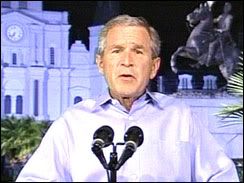 He also, famously, showed up for his photo-op speech in New Orleans following Hurricane Katrina, a disaster whose scope he completely misunderestimated, with the intention of showing how large and in charge he was. Instead, he showed up with his shirt incorrectly buttoned: misunderbuttoned.
It all fits neatly together in my head, at least.
Thanks to Bitty for today's WOTD entry
Richy Will Never Be a Pirate
Richard knew that he wouldn't make it home to change in time for the performance, so he put his tux on before setting out for the hospital. He needn't worry about his trombone; it was already in the concert hall.
He set off down the street, walking very deliberately. The world titled a little with every step. He stopped. It still tilted. Oh well, he thought to himself, I guess it's going to do that either way, I might as well keep going. He began walking again.
He'd been off kilter for a few days, really off kilter, the universe in constant, personal, motion. On Tuesday he'd had a granola bar for breakfast, and ever since then, everything he'd tried to eat had burned his tongue. Between that and the sore throat, he hadn't had more than water and some applesauce all day. This morning – Wednesday – his vision had gone a little blurry, which made classes hard. Particularly the theory course. Professor Brown's tiny, cramped musical notation had become impossible to read, even from the front row of the lecture hall, and that was the last straw.
Nearly twenty minutes of toddering later, and Richard had found the hospital's vast parking lot. Among the signs pointing this way and that, he spotted the one for Prompt Care, and followed it to the right. Inside a pair of automatic sliding glass doors, he gave his name – Richard Hoffman – and insurance information – the university's – and symptoms to a permed lady behind the counter. Then he sat down to wait his turn, eyes closed. The world moved less that way.
The clock above his head read 5:13 when he next looked at it. Prompt Care, ha. Well, he though, it's not like I didn't need a couple hours of sleep. I hope they didn't call me yet, I think I would have noticed that. I hope. Just as he was settling back into semiconscious waiting, Richard heard his name.
The nurse led him into a little screened enclosure, where he was instructed to sit on an examining table. She seemed a little put off by the tuxedo, but she took his blood pressure and temperature, and listened to the itemization of his symptoms cheerfully enough, with no more than a handful of hhmmmms. Then she swabbed the back of his throat, as Richard tried not to gag.
She left. Richard reclined on the table and closed his eyes again. He didn't get quite the chance to drift off this time, as the doctor came up shortly, with a, "Richard Hoffman?"
To which Richard answered, "Yes. That's me."
"So, let's see," the doctor went on, "you're dizzy, your mouth burns and your throat is sore, blurred vision, anything else?"
"No, that's about it. Aside from the burning when I eat, my tongue is kind of numb though."
"Well, I don't really know what to make of this; you look fine. Let me try a few things here." At that, the doctor strode off again, but momentarily came back with a tongue depressor. She broke it in half and said to Richard, "Stick out your tongue please."
With some trepidation, Richard did as he was asked. The doctor began prodding at his tongue with the splintered end of the depressor. "What does that feel like?" the doctor asked.
"Ot ukh," Richard tried telling her around the stick in his mouth.
"What was that?"
"I said, not much. It doesn't really feel like much besides a little pressure."
"Hmm. Why don't we have you get a CAT scan?"
After the CAT scan, Richard was brought to the emergency room. The hospital's policy, though, was that patients must not be allowed to walk there. Richard was obliged to be pushed there in a wheelchair. On one hand, he found this ridiculous, he was perfectly capable of moving under his own power; on the other, not walking around did mean that the rest of the universe held a little stiller around him.
Once in the emergency room, it was discovered that they were short on space at the moment, and that there was nowhere to put Richard. And so he sat in the lobby there, in the wheelchair, wearing his tux, and with a blood pressure cuff around his arm. I feel like an idiot, he thought to himself. At least there are interesting things to watch here. And so there were, enough minor catastrophe to hold his minor morbid attention. Another young university man came in, with a lip ring, the flesh swollen and broken around it, looking like he'd been hit in the face. A mother trailed two small children, one of which was crying over skinned knees, while the mother was more concerned over his possible broken finger. Half of an older couple seemed to be having heart trouble, though Richard couldn't discern which one the complaint belonged to.
At last, there was a spot for him. Richard had begun to think that everyone had forgotten about him, as lacking in urgency as his condition was. The doctor who had prescribed the CAT scan came back, saying that it had gone very well, and it showed nothing wrong. The throat culture had produced no bad results either.
"Now, I know this sounds absurd," she continued, "but you've got sea-sickness."
"What? How is that possible?" Richard asked, "I've never been sea-sick in my entire life. And besides, the nearest body water bigger than the campus pond in a hundred miles away! I don't believe you."
"I told you it was absurd. Anyway, it's not exactly sea-sickness; there's a virus going around, it cause the symptoms of sea-sickness. Let me write you a prescription." She scribbled something out, and gave Richard directions to the pharmacy.
After filling the prescription, and finding a water fountain to swallow one of the pills with, Richard began his slow shuffle back to campus. On his way to the concert hall, while trying to straighten the wrinkles out of his tuxedo, he pondered over the afternoon's hospital visit. Saddest of all, was the dashing of his dreams of pirate-hood, having gotten sea-sick on dry land.
Submitted by Shaker rowmyboat
About the Work: "[This] is a short story, based on real life -- that is, a friend did actually get sea-sick in Syracuse, NY, and go to the hospital in his tux. When I heard, it was too good not to fictionalize."
The Dance
It began with ritual shouts and taunts of the sort that are often exchanged by people in thrall with their own power, or people who want to create a screen of false bravado in the hopes of distracting others from their actual weakness. This escalated to the immediate precursors of physical contact.
The participants intruded closer and closer into each other's personal space, the volume of taunts increased, facial expressions became more extreme, motions of arms and legs became more pronounced and threatening. The sound and spectacle generated a magnetic field, drawing an audience who started to mentally tally the worth of each participant, as well as the credibility of their threats, verbal and physical. (Wherever things can be measured - objectively or not - judgments and predictions inevitably follow...)
Pushing and shoving were added, increasing the instability of the situation and leading to a chain reaction breakdown of civility. Shoves quickly became blows, pushes became grabs as each attempted to gain physical dominance. Soon the first evidence of blood began to add additional color to the proceedings. The exchanges continued to increase in volume and savagery, the shouts dying down to simple grunts punctuated by the sound of blows falling on human flesh.
Soon the symphony of violence reached its orgasmic peak, as outraged fervor and physical and mental effort sapped the participants to exhaustion. The last few pathetic exchanges were made, providing proof the participants had been drained.
A final look or grimace was thrown, and the participants separated and began to make their way back onto the paths they followed before they crossed - their lives diminished in proportion to their destruction of civility. With the spectacle over, the audience also evaporated, each also diminished by witnessing the vicious behavior and the failure of social and behavioral rules.
The violence had indelibly marked, deformed, and cracked the thin shell of civilization that imperfectly covers our too often savage nature, and left both the participants and their audience alone to face another cold, hard, and unpleasant truth of human existence.
Submitted by MikeEss
About the Author: "I'm a failed student of the human condition..."
Thursday, July 24, 2008
Writer spotlight: Jon Goode
In keeping with the concept that a big part of our existence is to be a site where writers can be inspired, occasionally here at ShakesQuill I will post a story from another source about an inspiring artist or intriguing new works. Obviously, the other contributors are invited to post these types of stories, and other contributors and ShakesQuillers are encouraged to send me any stories they think should be featured.
While our main focus will remain our own work, reading about someone making their mark can be something that encourages us all. Which is why I chose to share this CNN story on poet Jon Goode:
Originally from Richmond, Virginia, Goode studied economics and finance at James Madison University in Virginia. His Southern-laced vernacular alludes to a rural upbringing. His bookish style -- starched short-sleeve button up with tie, wire-rimmed glasses and a straw boater hat -- is straight out of a Harper Lee novel.
Friends liken him to "a civil rights leader that listens to rap music." Goode's spoken word performances are drawn from a collection of personal stories, most of which are true, he says.
The seasoned wordsmith rose through the ranks to deliver his rhymes to the spoken word mainstream. He's done writing stints and made appearances for Nike, Nickelodeon and CNN's "Black in America."
But it was after an appearance on HBO's "Def Jam Poetry" that Goode really started to get noticed.
Goode says the trek to renown was not easy. For several years, he sent the same demo tape to HBO, hoping to get picked up on Def Poetry Jam. They told him he needed to be more animated, theatrical.
Read the full story at CNN.com.
Find out more about Jon Goode at Laymen Lyric Production.
Word of the Day
Bilious
Pronunciation: \ˈbil-yəs\
Function: adjective
The adjective for bile, bilious has five meanings, two being exclusively medical and three related to the "humors" of the body. The word "bilious" goes back to the old belief that there were four bodily humors (black bile, yellow bile, phlegm, and blood) and these four humors determined a person's temperament. "Bilious" was the personality type associated with an excess of yellow bile. The word "bilious" derives from the French "bilieux," which in turn came from "bilis," the Latin term for "bile." The five meanings are:
1) of or relating to bile.
2) suffering from liver dysfunction (and especially excessive secretion of bile).
3) indicative of a peevish ill-natured disposition.
4) sickeningly unpleasant
5) resembling bile, especially in color (yellowish-green)
"The bilious bastards who wrote that stuff about individuality for The Saturday Evening Post don't know anything more about real battle than they do about fornicating."
— Patton, 1970
Thanks to Faith for today's WOTD entry
Love's End
Ellie had once loved Richard for many reasons, but as their marriage finally came to its long-deferred end, none of those reasons seemed real anymore. She hadn't forgotten them; she could vividly recall, if only in fact of thought and devoid of associated feeling, the joy at seeing him enter a room once upon a time, or hearing his voice at the other end of a phone line. A memory of him--lying on their bed on a Saturday morning before they were wed, with the sun streaming in through the window and falling across his golden skin, lighting up the hairs on his forearm like tiny little flames--was still there, still easily accessible. She still found him beautiful, as he had always been, but his beauty was distant now, something only to be admired, but not loved. The reasons she loved him had slipped away from her, and had she tried to reach for them, her fingertips would have found nothing but a gossamer mist merely hinting at something long having lost its substance.
They lived like two ghosts in the same flat, even as the paperwork became final. It was a lovely flat, which neither of them wanted to leave, but neither could afford on their own. So Richard moved into the guest room, and they went about their separate lives, often going days without speaking, then sharing a dinner together, as if it were a perfectly natural thing to do.
Somewhere between love's beginning and love's end, Ellie began to consider that she had been so ready to love him, so eager and dedicated, that perhaps she had failed to notice that he had really never loved her at all. The thought weighed on her; she wondered, fleetingly but often, if she had been a fool. Had there been a time when he cared for her in equal measure, or had her own fervent devotion served as pale substitute for the mutual adoration in which she'd believed?
No matter now. She'd already fallen in love with someone else. Richard knew they were friends, his former wife and this man who lived some distance away, who took up Ellie's time with long and intimate phone calls. Sometimes he listened, from another room, to their conversations, felt his gut swell with envy as they traveled winding paths from subject to subject, books and film and music which he'd never read, or seen, or heard. Not that Ellie hadn't tried; still, petulantly, he'd regard her laughter, floating in from her bedroom, as a deliberate insult, and wonder why she hadn't been so keen to speak to him about these things--until a more reasonable part of him forced itself forward, reminding him that she had, and he had turned her away.
Ellie decided to tell Richard that she was in love this other man. It was a practical concern, in part; they would need to sell the flat. But it was also just something that Richard needed to know. She told him, hesitantly but candidly. He feigned happiness for her, even as his insides churned with jealousy. It wasn't that he wanted her, he told himself, but that he wanted what she had.
He wasn't sure it was true, but then again, Richard wasn't completely certain that he had ever cared for her in equal measure, either.
The week came when they were to leave the flat. Ellie's new partner, John, came to the home they were abandoning to a younger couple, and Richard met him, even though he didn't have to; he could have found countless excuses to be gone for the evening, any one of which Ellie would have gladly accepted. But his curiosity outweighed his impetus for self-protection, and any sense of propriety.
The three of them spoke, haltingly, inelegantly, over a bottle of wine, and Richard couldn't avoid the realization that the awkwardness was his responsibility. He was, at turns, too jovial, then too solemn. He persistently expected to catch Ellie and John shooting each other exasperated or pitying looks, but they did not, and he found himself having to resist an unreasonable agitation at their failure to indulge his suspicions.
Ellie and John were, unbeknownst to either, both proud of the other for deftly handling the uneasiness Richard wore on his sleeve. Secretly, quietly, admiring each other, they failed to notice much of his discomfited emotional fidgeting, which, in the end, made navigating it that much easier.
In spite of the simmering tumult, Richard liked John. He watched, more obviously than he should have, John and Ellie interacting, his hand on the small of her back, leaning in to listen to her with an intent expression of interest Richard couldn't recall having ever offered. They were, together, precisely as his eavesdropping had led him to expect they would be.
When John left that evening, Richard approached Ellie with an uncharacteristic candidness. He told her that John was a good man, that John would be able to love her in a way that he never could.
Ellie gave him a half-smile, and nodded. And with that, they were both free.
In Memoriam: "I Love My Life!"
When I looked at the calendar today, it wasn't immediately apparent why it seemed like there was something about the significance of the date that kept gently nagging at me. And then I remembered…ah, yes, that was it. A year ago today he died. A week after that, he came to me in a dream, the memory of which I recorded in my journal at the time: I was in the living room and heard a knock on the door. Before I could answer it, I saw him in the entryway or—to be more exact—I saw through him. In that lucid-dream moment, there was no mistaking that he was dead. He appeared not as a ghost, exactly, but not as someone of this dimension, either. He strode purposefully across the room, making his way from one end of the house to the other. He spoke no words, but turned toward me in slow motion, acknowledging my presence with only a nod and continuing on until he was out of my sight. He carried a briefcase, which is a puzzling detail because, although we had been work colleagues, I don't ever recall seeing him with a briefcase at the office…
He had been diagnosed with brain cancer that January and had been given only three to six months to live, managing to almost make it to his 37th birthday last summer. Although his time on earth was tragically short, I personally can think of no one who even came close to cramming as many experiences and as much joy into that brief a lifetime. Perhaps, some of us even speculated, it was almost as if he had known on some unconscious level that there was a reason he needed to live his life at warp speed.
One of the two cruel ironies about his diagnosis was that he was an intellectual who was curious about everything. Having been double-promoted in school, he began college at the age of 15. When he graduated, though, having already been kicked out of his home after revealing to his parents that he was gay, he left the rural, small-town bigotry of his West Virginia family and surroundings to begin a new life and career in the big city. Because his mental acuity played such a large role in his self-identity (after all, this was a person who solved math theorems online for fun), it was painful to see his brain fail him. As his illness progressed, he had to resort to applying post-it notes all over his condo to remind himself of not only the names of objects, but of other aspects of his life, as well.
After receiving his diagnosis, he made the decision not to pursue any radical or invasive treatment, opting only for medication to manage the pain. He quit his job as membership director at the New Thought church we attended and where I had worked with him until the year before. He had been a tireless advocate both for members of the congregation and for dozens of organizations in the community outreach program that he oversaw. But at that time, when the Chicago winter was at its harshest, his greatest wish, he said, was to spend a few weeks in Puerto Vallarta, Mexico. In an email sent to friends before he left, he wrote: "I am preparing for my trip to the ocean; to swim with the dolphins, to take pictures of the sunset, to lie in the sun, to read, to write, to just be. My intuition tells me that this journey is not my last but that it is significant."
Well, he sure was right about that—which leads me to note the second great irony of his illness. Although he had made many attempts in his last year to find that special partner with whom he could create a long-term relationship, true love had managed to elude him—until he went to Mexico, that is. I'm sure no one was more surprised than he when he met and fell madly in love with a wonderful, handsome, smart and caring French-Canadian vacationing at the same resort. And not only that, but this new man in his life—who could have easily chosen to just enjoy the couple weeks they had together and gone his separate way—instead decided that he wanted to spend with my friend whatever time he had left. I was both thrilled for him and furious with the utter injustice of it all—I mean, what the hell kind of cruel trick was the universe playing on him, anyway? In the months that followed, though, he and his new lover would fly back and forth from Chicago and Montreal, as time and health would allow, until they finally announced that they decided to get married in Canada.
One of the most amazing things about his final journey was the incredible grace and humor with which he faced his rapidly approaching death. While he definitely suffered many dark moments of the soul, he was able to give his husband, friends and colleagues the gift of a valuable life lesson. By speaking freely of the mental, physical and spiritual challenges that his illness presented, he opened up the possibilities of us having authentic conversations with him, rather than relying on empty platitudes or attempting to ignore or deny the inevitability of his demise.
Typically, our conversations began with him telling me something funny that recently happened to him, followed up with an exuberant "I love my life!" Then he would pause and ask me, "but how are you doing?" Admittedly, I had been experiencing a serious financial crisis at the time, but I responded, "Yeah, right, like I'm going to whine to a person with terminal cancer about my problems—I don't think so!" And then we'd laugh.
Although he had told us that he did not wish to have a memorial service after he was gone, we were able to talk him into letting us throw him a "Celebration of Life" party—and what a celebration it was! With 300 people in attendance, he shared with us his favorite stories, songs, poems, cartoons and quotes, while we reciprocated with our appreciation and thanks for his contributions to and presence in our lives.
In a special message he prepared for the occasion, he wrote: "I love my life" has been my mantra for a very long, long time, and it is true. It is also true that you are the reason. Every one of you has touched my life in amazing and remarkable ways, and there are no words to thank you enough…This is not goodbye, just so long. We were attracted to one another in this life for a reason and, while I don't know why, I do know that this is not the end of our relationship with one another, it is just part of the journey. It has been my pleasure to have shared this life with you.
At the end of this celebration, he bestowed upon those of us with whom he had worked the gift of a small globe. It had special meaning to him, he said, dating back to when he was a small child on his first day of school in that small Appalachian town. He had become excited, he went on to explain, when his teacher took out a map of the world. First, she showed the class the tiny dot that represented where they lived, and then went on to explain where they were located in relation to their state, country and the rest of the world. Even at that young age, he came to the sudden realization that he was not destined to stay there—some day he would be able to leave to pursue adventures in other places! He rushed home to tell his mother of his epiphany and was crestfallen when she wasn't able to comprehend the importance of what he was trying to convey.
Early last July, he called me for what I clearly understood at the time was to be our final conversation. What was remarkable about it was that it was perhaps the longest talk we had ever had. Prior to his illness, he had been such a whirling dervish that the idea of him sitting still long enough for a two-hour chat would have been unthinkable. Although he was in severe pain, he chose a time to call during a rare window of lucidity, and he spoke with his usual candidness. He confided to me that he had been having recurring dreams of his twin brother who had died when they were 12 years old and surmised that he was waiting for him. In some dreams, he said, his brother appeared as the child he was at the time of his death; yet, at other times, his image was that of an adult. In sharing a belief not of heaven or hell, but of an afterlife nonetheless, we also talked of his expectations of what he thought it would be like after he made his transition. He promised to communicate with me, too, if it were possible.
Two weeks later, his unbearable pain came to a merciful end.
The little globe he gave me now sits on my desk in my bedroom, a daily reminder of not only a special person who graced my life for too short a time, but also of the adventures that may yet still be in store for me. On this, the first anniversary of his death, I just want to tell him that I love him, I miss him and, oh—by the way? I figured out the meaning of the briefcase…
Submitted by Constant Comment.
About the author: Constant Comment, a Chicago-area resident and longtime commenter and occasional contributor at Shakesville, has spent 36 years in various incarnations as a writer, editor, researcher and proofreader. While she is currently employed as a writer/analyst at a legal publishing company, working in the area of labor and employment law, she is grateful for the opportunity here at Shakesquill to stretch a little more creatively than she is used to.
Wednesday, July 23, 2008
Word of the Day
Leitmotif
Pronunciation: \LYT-moh-teef\
Function: noun
1. In music drama, a marked melodic phrase or short passage which always accompanies the reappearance of a certain person, situation, abstract idea, or allusion in the course of the play; a sort of musical label.
2. A dominant and recurring theme.
"As is so often the case in a crazy household . . . guilt becomes a leitmotif."
— Frederick Busch, "My Brother, Myself", New York Times, February 9, 1997
Thanks to Constant Comment for today's WOTD entry
Tuesday, July 22, 2008
Word of the Day
Infix
Before we get to today's word, let's review. In elementary school, we learned all about prefixes and suffixes. At least, I hope we did:
Prefixes are those little add-ons that go at the beginnings of words. (These are called "roots" by most of us, although to linguists it's a little more complicated – prefixes actually attach to morphemes, not words, but since I'm not a linguist, I'll back away from getting myself in any deeper. For purposes of this discussion, let's stay with the elementary school definition.) A prefix modifies the meaning of the word:
clear — unclear
cancerous — precancerous
decisive — indecisive
Prefix itself is a word with a prefix:
fix — prefix
Then, there's the add-on that goes on the end of a word and also modifies its meaning, the suffix:
guile — guileless
energy — energize
However, in many languages other than English, a common modifier is the infix – an add-on that goes in the midst of a word.
Here's an official definition from the American Heritage Dictionary, via Dictionary.com, although most of the definitions I found – including this one – would not be all that helpful without further information. Here is the definition of the word as both noun and verb:
in•fix (ĭn-fĭks')
tr.v. in•fixed, in•fix•ing, in•fix•es
1. To fix in the mind; instill.
2. Linguistics To insert (a morphological element) into the body of a word.
n. Linguistics (ĭn'fĭks')
An inflectional or derivational element appearing in the body of a word. For example, in Tagalog, the active verb sulat "write" can be converted to a passive, "written," by inserting the infix -in-, yielding sinulat.
[Back-formation from Middle English infixed, stuck in, from Latin īnfīxus, past participle of īnfīgere, to fasten in : in-, in; see in-2 + fīgere, to fasten; see dhīgw- in Indo-European roots.]
And while in English the infix is less common, it seems to be gaining some ground, coming to us through what is seen (again, not by linguists) as non-standard language.
Hip-hop employs the occasional infix. The best known have been popularized by Snoop Dogg: "izz" and "izzle" have made their way into at least some of our vocabularies.
But I offer all of this is to get us to this one point: Hip-hop notwithstanding, infixes are rare in English. However, there is one beloved to many English speakers, which we use as an intensifier: fuckin. (Even the more refined of us will often use its more modest fraternal twin, freakin.)
We absofuckinlutely love it.
We find it fanfuckintastic.
It is unfuckinbelievable how much we love it.
Like so much else about grammar, English speakers who use this infix don't have to stop to think about the formal rules regarding the infix, or how rare it is – they just use it, with enthusiasm.
Thanks to Bitty for today's WOTD entry
A Hint of Sandalwood
I found the tapes at the bottom of my closet, which was strange, since I had long ago upgraded to DVD some time ago. Four clean black boxes with white labels, each of them addressed to a different person. One was addressed to a well-known movie director; when I opened the box for this one, the director's home address, phone number and e-mail address were printed on the inside of the cover in very pretty handwriting that clearly wasn't mine. One was addressed to a man I had never heard of, but apparently he was a doctor of some sort, based in Boston. One was addressed "to my mother"; I opened the box to find a label with an address to a woman in San Francisco affixed to the inside cover.
The last box was blank on the outside. I opened the box to find a tape with no markings, but the inside of the box said only three words: "For my love."
I went out to the garage and hunted around in the stack of old electronic boxes that I kept for no apparent reason. For some reason, long ago I decided that tinkering with gadgets was what I was good at, so I always kept a small supply of old devices around to cannibalize and slap together into interesting configurations. I was reasonably certain that I had an old VCR among the old game systems and broken record players, and soon enough I found a small box that I had purchased cheaply from the local big box store. Finding the necessary cables to connect to the flat-screen TV in my living room, I returned to the house and hooked up the box.
Lifting the tape gingerly from its case, I wondered again if I somehow had stumbled across someone else's old memories, whether or not these tapes that I had found belonged to a former girlfriend who had left them in among my things and I had just never cleaned them out thoroughly. Yet, feeling the heft of the tape in my hands, somehow I knew that this tape was mine.
Inserting the tape into the old machine, I pushed PLAY and watched as the snowy screen resolved into the shape of a living room not unlike the one I was standing in now. There were differences, of course - for instance, the giant window showing the wide blue sea in the background - but it was still a nice looking living room all the same. Paintings and various pieces of art decorated the walls. A well-apportioned library sat off to one side. A matched pair of very nice French chairs was placed in the center of the room. And in one of the chairs sat the most beautiful woman I have ever seen, her hands folded in her lap, a fragile smile on her face.
"Hello, Anthony," she said in a rich, melodious voice, with an exotic accent I could not place. "My name is Anna, and even though you and I have never properly met, I am your wife."
I wondered if she could see my confused expression, because she next said, "Yes, I know this might be quite a shock to you. You weren't expecting to find these old tapes, but I put them there for you. You are probably wondering if this is some kind of elaborate joke that one of your friends is playing on you, but rest assured that such is not the case. I am – " and here she paused slightly, swallowing and struggling to continue, before she regained her composure and said, "was your wife for the past sixteen years."
Here again she paused, and I realized how close to breaking down she was, how she needed all of her strength to finish this strange message. She held up her hand, as if to tell someone off camera not to come further, and composed herself before she continued.
"You will not understand everything I am telling you, so please listen with an open mind. I don't even understand most of it, and I worked with you nearly all of your life. Nevertheless, in a little while, I will probably be gone, erased from all existence. I have run the calculations several times, and I am certain of this. Others have tried to achieve a solution to this problem that would enable this world to continue to exist, but they were unable to come up with a resolution. Like it or not, I am the reason for what's happened here, the key, if you will, to ending the curse that befell our world. And for the good of a world that will never remember that happened here, I made the choice to sacrifice myself. You argued against it, of course; you railed and carried on for days, but, in the end, there was nothing else that could be done."
Her eyes bored into mine and seemed to carry a world of pain and loss that I could not understand. I had never met this woman before, and here she was speaking of the two of us as if we had spent a whole life together. Surely this had to be some sort of joke, some foolishness that my friends Bret or Amy had decided to play on their resolutely bachelor pal. I contemplated turning off the machine and tossing the tape in the trash, but before I could reach for the controls, the woman on the tape spoke my name again.
"My love, you may not believe me, but I want you to wait for one moment longer and listen. You devised a way to keep my alive, if only in your memory; a way that would survive the changing of time and space itself. I'm not sure that I understand all of it - you were always so much better at such metaphysical things than I was, but all that it required is for you to watch the next few seconds of tape. If you still want to throw this away after the recording is done, then do so with my blessings, but please, please wait until the end."
Here, she nodded at the person off camera, and the snow briefly returned for a few seconds. Nothing but snow, really, and then the woman in the room returned to the screen.
"Thank you, my love. I know now that we will never again be apart. Farewell."
The screen went dark. The tape was done.
Strange, I thought. I considered pitching the tape and its companions in the trash, but decided to wait for a bit. I yawned and stretched for a bit, suddenly in dire need of a nap. I went to my bedroom and lay down on the bed. As I lay there in the few moments before I drifted off, I thought about the woman on the tape. She was very pretty; once I woke up, I would ask Bret about her (and this kind of joke could only have been perpetuated by Bret; he knew so many pretty girls in his line of work, and no doubt he got one to do this for his often-lonely best friend as a not-too-subtle message to "find some girl already and settle down") and get her phone number.
Then the room faded away into the shape of a pier overlooking the water. The beach seemed to stretch for miles in either direction, and I had never seen so clean a body of water or so white a sandy beach before in my life.
Anna was there, wearing a blue dress near the water, and strangely enough, I was there as well, laughing and holding her aloft, just two young people very much in love with all the time in the world. I knew where the beach was, and I remembered how many times we had visited this particular stretch of beach over the years. A Rottweiler puppy ran around us, happy as can be, barking and playing in the surf as the sun went down.
The beach soon faded from view, and then we were in a kitchen, our kitchen, and I was cutting vegetables while she stirred a pot of brown stew on the stove, the fragrant aroma making our mouths water in anticipation. She wore one of my old t-shirts and her favorite pair of jeans; her hair smelled of sandalwood, and I marveled over the fact that I could pick out that scent over all the other smells contained there. She smiled at me and told me that to thank my mother for this recipe.
The kitchen faded away into a darkened room, and we were arguing about something. We both said words that cut deeply, even though neither of us wanted to give them voice. The tears that ran down her cheeks cut at my heart, and even though I tried not to say the things that hurt her, I did it anyway, feeling my foolish pride take control of my lips. She ran into the room and closed the door, and I could only feel anger and regret.
That room faded as well, and suddenly it was night and we were on our bed, and she was above me, and we moved together as one, and I never felt more alive than I did in that moment. Her hair fell everywhere and I could smell the sandalwood again over all of the other scents in the room, and I knew that there could be no greater thing in the entire universe that what we felt at that moment.
All too soon, that room faded into my lab (of course, it was my lab - who else could it have belonged to?) and I slammed my fist down on the table, sending various solutions flying briefly into the air, unwilling to entertain the facts that were staring back at me from the readout on the screen above my head. She was there again, holding me from behind, crying softly. I turned to hold her and swore that I would do everything I could to keep her alive, I would find a way somehow, all I needed was more time that I knew would not be forthcoming.
Then the lab faded to darkness, and she was there, waiting for me.
She smiled sadly, walking over to where I stood, and put her arms around me. We held each other for a long time before I spoke.
"What happened?"
She lifted her head from the crook of my neck (God, the way she did that fit so perfectly) and shook her head. "It doesn't matter anymore. Everything is back to normal now, and trying to bring me back will only cause you and everyone else untold pain."
Even though I was no longer that scientist that I had seen, I still said the words anyway. "I can still save you."
She put her slender fingers on my lips to shush me. "I know, my love. I know."
Those tears that could tear my heart apart more effectively than the sharpest of knives started to flow from her eyes, yet she never cried. She smiled again for me and said, "It's enough that you remember us and all the good times we had together. We had seventeen wonderful years, my love, and I would not trade one of them for anything. But you've been lonely for far too long in this world, and that's not right. You have always needed to move on from the pain, even if you never understood why you hurt. And that's why I'm here, now, in your mind, helping you to continue. Live your life, my love. It's time to wake up from the dream that was the two of us and live.
"Live for me."
I sat up in the bed, wide-awake in an instant. Dusk had begun to shroud the outside world in darkness. My bed, always a bit bigger than I would have liked, never felt emptier than it did in that moment. And for the first time in my life, I wept for my lost wife, for my lost world, for a world I could never have. I felt every bit of the pain that had stopped me from having a proper relationship with the few girls I had known in my life, and I did not stop crying until the oncoming darkness outside had rendered all black.
I got up and left the darkened bedroom, making my way to the living room, where the old VCR was still set up under the TV. I carefully ejected the tape and returned it to its case. Walking over to the study, I gingerly place the box in the bottom drawer towards the back, locking the drawer after I had closed it. I then spent the next few hours rummaging around for mailing supplies to send off the remaining tapes to their respective recipients.
I am not sure why I did so, but it felt like something that she would want me to do. With each of the letters, I enclosed a small note stating that I had instructions to mail the tape to them.
I dropped off the three boxes at the post office the next morning and tried not to think about them again.
Three weeks later, I received a phone call from San Francisco. An older man with a slight Eastern accent told me very pointedly never to contact his wife again, or he would call the police.
A few days later, I heard from my lawyer. He just finished a conversation with the director's people, who were adamant about making the tape he had received into a movie. He gave me a very large number and said that the director wanted to know if I had any more stories like these, as he was willing to pay for them. I told my lawyer to handle all negotiations and give himself a healthy percentage. I also told him not to bother me with calls like this anymore. The director went on change most of the story to his liking, making a boatload of money and winning several prestigious awards, although he was cagey in interviews as to who wrote the original story.
The next day, the doctor from Boston called to thank me. He was writing a paper on a possible universal cure for cancer, and said that the information that I had passed on to him had been invaluable. He wanted to give the scientist who came up with the research proper credit for providing the key to the cure, but the tape he received from her had been very explicit on that score: no credit whatsoever. He called to thank me profusely. I mumbled something and ended the conversation.
Soon thereafter, I sold the house and moved to Laguna Beach, California. The weather is very nice here year-round and the beach is visible from my window, even if the wildfires do make a fine haze now and again. I'm seeing a nice young woman named Beth, whom I met at the local animal shelter. We picked out a French bulldog she named Otto.
I don't mention the tape.
We don't have much in the new house; I sold or gave away most of the junk I had been collecting over the years. I do, however, have a very well apportioned library and a pair of matching leather chairs in the middle of the room, but those are mainly for show.
We usually spend our evenings watching the sun go down on the ocean. We sit snuggled together in a large swinging chair, a blanket over our legs, Otto safely ensconced on the rug by the door, and watch the people on the beach until the moon comes out.
And on those rare perfect evenings, if I'm fortunate, I catch a brief hint of sandalwood on the wind.
Submitted by Steven Perez, Thoughts From an Empty Head
Monday, July 21, 2008
Word of the Day
Amanuensis
Pronunciation: uh-man-yoo-en-sis
Plural: Amanuenses
Function: noun
Etymology: Latin, from a, ab + manus hand
Date: 1610
A person whose employment is to write what another dictates, or to copy what another has written.
"If she is telling me the truth then I am her biographer. Otherwise, I am just an amanuensis."
— Diane Setterfield, The Thirteenth Tale
Thanks to Constant Comment for today's WOTD entry
The Indian Queen, Chapter 1
Title: The Indian Queen
Author: baltimoreandme
Type: historical fiction/fantasy novel
~a novel of manners~
Prologue
Near evening, a crew of fishermen worked on a sternwheeler several miles from shore, shouting over the roar of machinery as the net-wheels creaked and groaned. The sea was bright and flat and the wheeler cast a long black shadow on the water. Slowly, the bulging net emerged from the water, ropes dripping. Steam-powered machinery moved it over the deck, where it obscured the reddening sun for a moment, and then the operator loosened the claw, the net dropped and swung in the air and the catch slithered into the hold. Miles away across the water, thunder rumbled. No one looked up.
Beyond the stretch of calm, a towering mass of clouds hung above the water. It extended from north to south as far as could be wheeled, from where the sea was solid ice down to where, from the older maps, the Europers knew a vast continent diminished to a point. Nearest the water there was rain. Sheets of water whipped and billowed out like sails over the ocean, gray and then suddenly white-gold, too bright to look at as the sun penetrated some unknown grove deep in the storm. The wind dragged the water, shrieking and howling, into whorls and icy ribbons that tore up and down the Atlantic. Higher up, lightening snapped and flickered. Bolts of electricity left caverns in the air and the air rolled booming back into the hollows.
At sunset the thunderheads stretched tendrils of vapor creeper-like out over the empty air. Descending light slanted beneath them, sparkling on the water and turning the edges of the storm red and gold. This is what the fishermen on the sternwheeler saw, what they and others had seen every evening for nearly two hundred years.
The last crossings had been made in 1687. On those ships came the last of the New English governors, the entire Mather family, the gentleman planters of Virginia and most of the House of Burgesses, sixteen families of free Africans from Carolina, Dutch merchants from New Amsterdam and Fort Orange, and a phalanx of shame-faced Jesuits from New France who had failed to find martyrdom in the new world and decided, after all, that they did not want their bones to rest in Amerigan soil. Those who made the last crossings brought letters, some of them, from the greater number of colonists who had been forced by poverty and distance to remain behind. Some, particularly in New England, had refused to leave.
Now, on a mild September evening in 1875, the master of the fishing vessel glanced out at the storm as his crew prepared to turn homeward. He squinted, shaded his eyes, and then lifted his spyglass. He had not been mistaken. There was a rent in the clouds, a narrow tear, wide enough for perhaps a single wheeler, and even then, even the slightest breath of wind would blow rain across the deck. Yet it did appear to be a real passage, not merely a trick of the light. Such openings were rare, and most led back into nothing but a howling, yellowish twilight of rain and sleet, strong enough to tear apart the bulkheads of a cross-ocean Indiaman. Nevertheless, an opening must be reported to the Meteorological Commission. They would decide what, if anything, was to be done about it.
Part One
One
On a rainy night some four months after the master of the fishing vessel had sent his telegram, Mr. Thomas Hutchinson, a high-ranking employee of the Meteorological Commission's Board of Plantations, entered Vachier's Theater from the rear alley and made his way through the backstage darkness, past water stained cardboard cartons and discarded scenery, toward the wings. He had been ending his evenings here for some time, and his face, if not his name, was well known. The costumer's daughter, who did stage-makeup and the odd bit of mending, was sitting at a little table with a whale-oil lamp, stitching a patch onto a coat. She looked up when Hutchinson passed by her table, and he raised his hat.
Other pairs of eyes belonging to stage-hands with yellow palms and dirty fingernails, errand boys and boilers of tea, actresses still in make-up and assistants to the director, marked Hutchinson's progress but looked away with a wink or a little smirk as he came near. He was not an inconspicuous figure. A tall, neatly-made man of about thirty-five, his bearing and, more than this, his black, gold-trimmed tri-corner hat and the style of his shirt collar, marked him as an off-duty official of the Commission. He wore spectacles, very thin ones with gold frames – this mild, almost playful myopia was really the only physical defect he could boast of – and his long legs were enshrined in a particular style of close-fitting white trousers and tall, highly polished black boots that were the style that winter. The shoulders of his coat were damp from the rain. Had one stood close enough to him one might have noted a soft aroma of expensive scent mingling with the less pleasant smells of boot oil and wet wool.
Nearby, a young man sat smoking meditatively under a rack of pulleys mounted on the wall. The pulleys and ropes were a peculiar feature of Vachier's. One saw them, sometimes with ropes run through them, sometimes not, but it was never clear where all those ropes went, or what the other ends of them were attached to. Certainly there were far too many for the scenery alone to account for them. "Evening, sir."
"Good evening." They kept their voices low so as not to disturb the business on stage. "Where are we?"
The young man, whose person seemed to exude the smell of mold, dry-rot and dust-hardened velvet that pervaded the theater, peered out onto the stage, squinting a little as he listened, and then nodded. "Act three, sir. Nearly there."
The production in rehearsal on the stage was Dryden and Howard's The Indian Queen, with music by Henry and Daniel Purcell. The magician Ismeron, smeared with brownish grease-paint and wearing nothing but sandals, an embroidered skirt and a great deal of faux gold jewelry, stood at center stage singing to the gods:
" . . . ye powe'rs that dwell with fates below
and see what men are doom'd to do,
where elements in discord dwell:
thou god of sleep arise and tell
great Zempoalla what strange fate
must on her dismal vision wait . . . "
The blonde, round-faced young woman cast as the Aztec queen Zempoalla was wrapped in long robe of threadbare red velour, edged with little copper buttons, and Mrs. Bowler who did the costuming had pinned feathers, dyed red to match the robe, into her hair. Zempoalla listened with an appropriate amount of attention to Ismeron's song, while offstage on the side opposite Hutchinson the God of Dreams awaited his cue. The harpsichord was out of tune (it was really a miserable object, that harpsichord) and it seemed that Abigail had lost her battle with Lightwick, the musical director. She and the other five violinists, invisible in the pit, played with heavy vibrato – this, as she had been at pains to explain to the stubbornly fashionable Lightwick, was in contrast to Baroque practice. Hutchinson had not said so, but he preferred the music as they styled it now to the flatter, if more authentic sound of the 1690's. There was, after all, such a thing as progress in the world.
It was nearly six o'clock, and Hutchinson's watch had not quite touched the hour when Lightwick cut off the orchestra. The music halted, there was a clatter of wood on wood as something in the pit fell the floor, and, on the stage, Zempoalla began plucking loose the hairpins that held her feathers in place.
With the orchestra silent, Hutchinson heard the rain drumming on the roof high above. The theater was dark, but in the gaslight he could see the faded blue sky painted on the ceiling, a false dome ringed with cherubim modestly wound in red ribbons. Stoop-shouldered Lightwick emerged from the pit with his score in a cracked leather folder under his arm. He nodded to Hutchinson as he passed him, leaving in the air a lingering smell of cabbage and old paper that slowly dissipated among the curtains. More voices were now raised in conversation. A woman laughed, and the alley door opened and closed again with a bang. "No, it's lovely. I've always liked it. But Le Domino Noir is absolute rubbish." Abigail's voice was soft, but her accent, far too polished for the orchestra pit of a cross-river music hall, had a way of making itself noticed through the noise. She and her stand partner, Gustaf Mysliveček, reached the top of the narrow wooden steps that led from the orchestra pit to the edge of the stage. Abigail caught sight of Hutchinson then and smiled, but turned back as Gustaf touched her elbow to regain her attention. The young violinist pushed his black hair out of his eyes as he asked some question Hutchinson didn't catch. Gustaf was from Bohemia, and tended to speak very softly, bent close toward his interlocutors – no doubt, Hutchinson thought, to ensure that the smallest possible number of people heard the mincemeat he made of English.
"Tomorrow afternoon," Hutchinson heard Abigail say. The two violinists shook hands goodnight, and Gustaf set his violin case down to straighten his greasy felt cap and tuck the ends of his muffler into his coat. He had pale, oddly thick hands that one did not all imagine as being suited for the violin. But suited they were, it seemed. Abigail rated him a gifted musician, and Hutchinson did not doubt her judgment on this matter.
Abigail Bridgewater was the oldest daughter of Henry Bridgewater, Sr., corpulent mandarin of the Bridgewater Canal and Transport Company. Most of her theater acquaintance, if they had heard of the Canal and Transport Bridgewaters at all, assumed that the name was a coincidence, and none had been corrected on this point. Abigail had learned to adjust her manner to suit her circumstances and either was or had become (Hutchinson preferred to think of this skill as a recent acquisition) quite handy at telling harmless lies and brushing away questions about the origin of her beautiful violin, her well-tailored dresses, her velvet cap, her Etruscan bracelets and strings of amber beads. She was suspected in some quarters of thievery and in others of darker crimes still, but as no one had any evidence of her supposed criminal exploits she was either given the benefit of the doubt or accorded a certain amount of grudging respect for her skill. Like any good creation of the theater, Abigail Bridgewater was quite clever at coaxing a willing suspension of disbelief from her audience.
And a thief at her boarding house had inadvertently done her a good turn with regard to this matter of credibility by stealing most of her old winter things. The boots she wore now were missing a few buttons and her black overcoat had been made over from a man's. The lapels were threadbare, the elbows patched, and a full three inches of her dress showed beneath the ragged hem. This was evidence enough of poverty to clinch the matter, and poor Gustaf had not the dimmest notion that he shared a music stand with the Miss Bridgewater who had once danced with the Prime Minister's son at the Meteorological Commission's annual ball, and more importantly, who had nearly married Andrew Ridley, the oldest son of the Earl of Huntingdon.
At the time, Hutchinson had wondered, in a passing sort of way, how Abigail had managed her Ridley conquest. She had a glow of health about her and a certain broad-hipped showiness of figure (one expected as much from the Bridgewaters, someone had once said to Hutchinson at a party) but her face was no more than ordinary, and acne had left a scattering of pockmarks across her cheeks. It had seemed to him at the time that Ridley might have settled on one of any number of better looking and equally rich young ladies. "It would have sounded far more authentic without the vibrato," he said, taking her violin case and satchel as she buttoned her coat.
"I told Mr. Lightwick as much." She tugged on her gloves and did up the tiny mother-of-pearl buttons. "But what can one do. Poor Mr. Purcell." Abigail adjusted her hat and reclaimed her violin and bag as they made their way to the alley door, where she stopped and retrieved her umbrella from a tangle of them in a cardboard box.
Hutchinson opened the door as Abigail snapped her umbrella open and they stepped out into the alley. Water rushed past their boots and pounded on the umbrella as they walked, arm in arm, toward the street. Hutchinson waved down a cab and the driver, bundled up in a creased and cracked coat of waxed canvas, opened the door for them. Hutchinson stood aside as Abigail climbed in. Water dripped from the sodden hem of her dress. Hutchinson closed the umbrella and followed her, and the driver closed the door.
"Did Mr. Schlegel's friend have any news about the telegram?" she asked as he brushed the rain from his hat. The accent in which she spoke to him was a less self-conscious version of the one Gustaf or Lightwick heard in the orchestra pit. It was the natural version, learned from childhood, of the speech her grandparents had worked very hard to acquire, an accent that hinted at pianoforte lessons and solid silver tea services but – unfortunately, inadvertently – at the same time it whispered of money rather than rank. Every now and then one detected in it the color-reversed afterimage of a counting house. Nevertheless, all the marks of good breeding were there. The dropped ‘r', the heavy drawl attached to the vowels, all were present and accounted for. A trained observer might have noticed that there were a number of discrepancies between Hutchinson's accent and Abigail's – a trained observer might have wondered if the commissioner's parents hadn't been working folk, or his father a low-level clerk in some sort of holding company – but had the trained observer been polite, he would not have mentioned it.
"Just this morning," Hutchinson said. "The Lyon got back last night, and it seems to be genuine. I hardly believe it myself, but they've taken daguerreotypes, and one of the boats went in. Nearly three miles."
Abigail had been watching the wet streets through the window of the cab. Lamplight from outside flashed for an instant across her neck and the lower half of her face. "Does it lead all the way through?"
"It appears to." Hutchinson reached out and steadied the umbrella, which had been about to fall to the floor. "And it's in our waters. Although one doesn't necessarily trust Farnsworth's judgment about these things after that business with France last spring."
"That wasn't his fault, I don't think."
"Perhaps not."
She smiled, and pushed a stray curl back behind her ear. Abigail's hair, a particular shade of dark brown
that reminded many people of scuffed mahogany, was rather too heavy to be properly disciplined, and often worked its way out of the pins. She had developed a habit of not washing it so as to keep it in order, which made it quite dark and glossy. This was said to be very romantic and vaguely Spanish. "But it's marvelous news. Who are you sending through?"
"No one as of yet. But of course we're considering our options. As a matter of fact – "
"Not you, Tom." Abigail's good humor vanished. Outside, the rain was turning to sleet. "Not you. You can't possibly."
"I requested it. Took a fair amount of doing, in fact."
Abigail was familiar with Hutchinson's penchant for ‘doing', as he put it, and forbore to comment on it.
"Wouldn't you, if you were in my position? Think of it – an entire continent, empty – " Hutchinson shook his head. "It boggles the mind."
"I would wait until someone else had gone through and seen that it was safe."
"We'll be armed, dear heart. I hardly imagine the Indians will be much of a threat."
"I believe that was precisely what Mr. Cortes said, once upon a time."
"But we know much more about the terrain than the Spanish did. And certainly our equipment is far superior." Hutchinson smiled. "I hardly imagine that a band of naked savages in quilted armor is going to turn us out of the New World."
The carriage jolted over the railroad tracks and Hutchinson lunged for the umbrella again, setting it point-down against the seat by his legs. "Well, if you must, I suppose," Abigail said. Probably she was thinking that he was, after all, not really her responsibility. She smiled. "Do bring me a scalp, if you can manage it."
"You can use it as a prop for your play."
"In that case, you might bring back an Indian or two. Our chorus is a bit thin since that last bout of 'fluenza. I wonder if any of them can dance."
* * *
During the night the sleet turned to snow and the wind began to howl around the chimneys and smokestacks, flinging scraps of dirty newsprint against the corners of buildings and winding rubbish in and out of the wheels of cabs. The snow-filled air glowed greasy yellow near streetlamps and windows. By the time it began to grow light, several inches of snow, already gray with soot, had fallen on the streets and the frozen mud in the gutters.
Abigail woke as she always did when the long low whistle of the 7:15 hummed in the window-panes. Only a block of warehouses and a weed-threaded fence separated her row of buildings from the railyards. She lay still for a few minutes, watching her breath condense in the chilly air above her pillow. The walls of her boarding-house were thin, and in the next room she could hear one of the other girls singing as she pinned up her hair. From downstairs came a clatter of dishes and the smell of sausages and strong black tea.
She pushed aside the quilts, which exuded a faint aroma of bacon grease, and sat up, drawing a long creak from the bed. Her feet were numb and the tips of her toes looked slightly bluish, but that always went away as soon as she had walked a little. She stood up slowly, to avoid the moment of dizziness she often felt if she got to her feet too quickly, and then dragged the chamber pot out from under the bed, hitched up her nightgown and squatted down to empty her bladder.
Today was Tuesday. She would teach four hour-long violin lessons in the morning, return to Vachier's at one to help Mr. Lightwick re-tune the harpsichord, stop for a brief plate of cabbage soup and some rye bread and tea with Gustaf in the cafe near his rooms, and then rehearsal until six. Perhaps a quick smoke and a cup of coffee, and then afterwards several hours of Mozart's The Magic Flute, which had been running for several weeks now.
Abigail washed her face, neck and ears, dressed, and stood for several minutes in front of her small, chipped oval mirror pinning her hair in place. Someone had stolen the heavy silver-backed brush her sister had given her, and for the last several weeks she had had to make do with a stiff-bristled wooden one with someone else's initials, V. M., painted in white on the back. The letters were surrounded by a little spray of pink flowers and green leaves, very pretty of course, but it did not make for the loss of her original brush. Abigail suspected Annie Trumbull, her nearest neighbor along the corridor, but she had had as yet no opportunity to investigate. Annie worked at a florist's shop – she always smelled of damp leaves and hothouse rot, and there was usually potting soil under her fingernails – and got every second Saturday afternoon off. This Saturday, Abigail knew, was one such holiday. She would go to Mrs. Stephens and tell her Miss Trumbull had borrowed a book of hers and she needed it back this afternoon, might she borrow the key? No need to come up with her, she'd only be a moment. Mrs. Stephens was a pleasant enough woman and rather stupid, no doubt she would imagine Abigail was no more devious than herself.
Suitably coiffed, Abigail stood for a long moment by the window and smoked a cannibulus, breathing smoke against the glass and watching people in frayed coats and faded dresses pick their way down the muddy street. The cigarette was in fact only a very small part cannabis; the rest was a mixture of various dried herbs that in burning gave off a sharp, crushed-flower smell and provided the little cigarettes' addictive power. It was an unladylike habit, she was well aware of this, but it didn't seem to cause any ill effects, other than a slight buzz between her ears if she smoked three or four at a stretch. It calmed her nerves, in any case, and she found she slept better at night after a nib or two.
She found a letter from her younger sister on her plate when she went down to the dining room for breakfast. The girl across the table, a Miss Etherington, watched nervously as Abigail once again forgot the proper procedure and put the tea in her cup before the milk. Without comment, she handed her the heavy white jug of milk (Miss Etherington, if the truth must be known, was rather afraid of Miss Bridgewater, and often handed her things spontaneously so as to avoid being asked for them). Abigail, eyes on Madgie's gossamer letter-paper, which undulated gently in the warm currents of breath from nine assembled boarders, poured some tea onto her saucer to cool and stabbed at her plate with her fork until she connected with a piece of sausage. Madgie regarded her sister's situation as entirely of Abigail's own making and refused to discuss any of the events that had led to it because she regarded these happenings – perhaps rightly, Abigail admitted – as things she was supposed to know nothing about. She had, however, finally consented some months before, after a great deal of silence and delay, to send her sister a few lines every now and then.
He lost St. Throgbellow's to the fellow from Hull. Papa is very upset. Henry is how you would expect. What's the use of Papa being Papa at all if Henry can't get a living? I hope you are well.
Yours, Margaret.
Abigail folded the letter and tucked it back into the large square envelope. Madgie always had the very latest in stationary; this particular envelope was made of a heavy, stiff paper that felt as smooth as butter under her fingertips. It surprised her that Henry had been turned down for the St. Throgbellow's position. It was a small and fairly unimportant parish church, and she had been sure the presentations committee would not be overly choosy. Nothing to fear though. There were other livings in the world, and Henry was rather young to be ordained. She picked up her saucer of tea, which was now rather cold, and tasted it. Far too strong, and of course here there was no jam to sweeten it. African sugar was murderously expensive.
The day wore on. Abigail wrapped her scarf around her nose and mouth, so that the whole world smelled of damp wool, and turned up the collar of her coat. Snowflakes clung to her eyelashes and spots of coal-soot, intermixed with the snow, smudged her coat. She had several small coins tucked into her left glove, but not enough for a cab, so she walked, head down, gripping the handle of her violin case in one hand and hugging her satchel close to her body with the other arm.
The snow lightened, then ceased and there were a few minutes of watery sunlight, just enough that the ice clinging to window-moldings and iron rails began to drip. It was impossible to look at the rooftops, the glare was so bright. Then, the light faded, and the wind picked up. Even through her scarf, Abigail could smell burning coal. She stopped in an alleyway a few blocks from the Slaters' and had a smoke. Her fingertips were numb before she had finished but she stuck it out, counting the bricks in the opposite wall as the smoke from her lungs joined the smog that brushed the roof-tops three stories above her head. Finally, she dropped the cannibulus to the pavement, ground it out with her boot-heel, and pulled her gloves back on.
At the Slater house, Mrs. Slater drew her aside and said, hesitating, glancing many times over Abigail's left shoulder into the dim and slightly shabby parlor, where young Annabelle sat picking at the embroidery on a cushion, that she had decided violin lessons were after all not the thing. She was concerned – well, she was concerned that the violin required too much moving about, especially with the arms raised like that. It wasn't ladylike. She thought she would try Annabelle on the pianoforte, where she could at least keep her elbows down.
Abigail chose not to mention that one did not normally play the piano with one's elbows tucked in like a plucked chicken. "Of course, Mrs. Slater." Mrs. Slater counted out a small pile of stiff blue-and-gold banknotes, folded them, and handed them to her daughter's music teacher. The thick paper crackled. "I've paid you for next month as well, Miss Bridgewater," she said. "I know we agreed earlier that Annabelle would continue through February, so it's only fair."
Abigail tucked the notes into the beaded purse that she kept in her inside coat-pocket and snapped it closed. "Thank you very much, Mrs. Slater. You're too kind. And I'm sure Miss Annabelle will enjoy the pianoforte," she added as she buttoned her coat. "She has a wonderful skill for phrasing. And if you ever need it tuned, please don't hesitate to send for me; I'll be happy to take care of it."
"You can tune a piano, Miss Bridgewater?" Mrs. Slater peered at her over her pince-nez. "Do you give lessons at all?"
"No, Mrs. Slater. I can play well enough to tune it, but I shouldn't call myself qualified to teach."
"Ah – well, a real pity, Miss Bridgewater. Annabelle did seem to take to you so. But I shall certainly remember about the tuning. I should feel much more secure if it were you than if I had to call some young man." She leaned a bit to peer into the parlor again, and lowered her voice. "Annabelle is getting to that silly age, after all."
"I would be happy to come whenever you need me," Abigail said, with what she hoped was a deferent and pleasant smile.
"Thank you very much, Miss Bridgewater," Mrs. Slater said as they shook hands. "You've been wonderful with our Annabelle – you have such lovely manners."
"Thank you, Mrs. Slater. Good morning."
Back on the street, Abigail tugged her coat collar a little more tightly around her neck. She would have to stop back at the boarding house and add the bank notes to the little stash wrapped up in her spare stockings; it was not safe to carry so much money in her pocket. It amused her that Mrs. Slater admired her manners, though. Most of her employers tended to remark on this, or something closely related, often her accent or her unexpected fluency in French. Abigail had a pet theory about this, which a number of kind remarks or overheard conversations in the homes of her students tended to confirm. "Her jewelry is precisely what one wants in a music teacher," Mrs. Russell had mentioned to her sister-in-law one afternoon as Abigail was listening to little Tobias Russell blunder through the meditation from Massenet's Thaïs; "I absolutely adore her hat," one of the Misses Ashby said to the other; "And her nails are quite clean," Mrs. Townsend told her husband. "Quite," said Mr. Townsend. "Lovely girl." Abigail had managed, half unintentionally, to be precisely what one wanted in a young female music teacher. She was clearly poor, but it was a well-washed and picturesque sort of poverty, and her shabbiness did not extend to dirty nails or a dirty face or the tiredness that is often the result of an inadequate diet. Her strings of coral beads and her velvet hat were exotic enough to be charming and go rather nicely with the shawl draped over the Towensends' piano, but one noted that her dresses were neither too tight nor low cut, she did not wear makeup of any sort, her teeth were excellent, and there seemed little danger that she would steal anything.
* * *
Hutchinson was late that night. Abigail sat down on a wooden crate near the alley door and buttoned her coat; with the candles and gas-lights out and the audience departed, it was cold. After a few minutes she drew from her sleeve the ivory cannibulus case she wore on a chain around her wrist and took out a nib. The draft from the door extinguished two matches before she was able to light it.
"Is he not coming today?"
She looked up. Gustaf was standing there, all bundled up as if to leave. He had probably seen her just before he reached the door.
"Just a bit late, I think."
"I should keep you company, maybe?"
Abigail smiled. "Certainly. Nib?" Gustaf drew one out and lit it with the match she offered. The crate she had taken as a seat was two narrow for both of them, so he remained standing.
"How was your teaching today?"
"Mrs. Slater sacked me this morning. She no longer needs me," she added, when she saw he didn't know the phrase.
He nodded, and drew in a lungful of smoke. "Very difficult, teaching. They do not like the accent, they do not like the coat, the child will not practice."
"But what can one do."
"Yes."
"And how is Magdalena?"
Magdalena was Gustaf's sister; she and her small son shared his rooms. Gustaf slept on a mattress in the larger one, and Magdalena and the boy shared the creaky iron bed in the smaller, which doubled as a kitchen. "She has a letter from her husband. We think he will come soon."
Magdalena's husband was always on the verge of appearing, but never materialized. Abigail had begun to suspect that he did not exist.
"Your friend would be angry if you go without him, no?"
She flicked a few ashes to the floor. "He wouldn't be – well, I doubt he would angry as such, but he would wonder if something had happened to me."
"I thought he might be your brother."
"No, my poor brother's not nearly so responsible. No one could ever count on Henry to arrive at the same place at the same time more than once."
Gustaf tugged at a loose thread at the cuff of his overcoat. "But you are not his – " he could not think of the appropriate phrase. "There is not an arrangement."
A patch of snow slid off the roof and landed with a muffled splut in the alley outside. "No."
"If he is rich – "
"No." Abigail opened her nib case, counted the cigarettes, and then closed it again and began to run her thumb back and forth across the ivory. The corners were smoothed, not sharp and hard as when she'd first bought it. They had used to scrape the insides of her wrist. "He is a friend of my family," she said. "He worries that I won't be safe, walking home alone after rehearsals."
"You wish he would not?"
"He thinks that I'm a person who needs to be protected."
"Protection is not protection, sometimes, I think."
"It's not that, Gustaf, really."
Gustaf did not argue. "Perhaps I might walk home with you."
"It is getting late, isn't it."
They were out in the alley, which was black and shining with melting snow, when a cab pulled up at the far end.
* * *
"You oughtn't to have been so rude to poor Gustaf." Abigail set her satchel on her lap and folded her hands. The leather was cold; she could feel it through her gloves.
"Poor Gustaf ought to have a care who he walks home with."
"You mean I ought to have a care."
"When we patch up this business with your father, it would help if you hadn't exposed yourself to any more disagreeable insinuations."
Abigail looked out the window and said nothing.
"Do you intend to grow old in a boarding house? You may consider poverty charming now, but twenty years would change your mind, I think."
"I'll grow old where I please."
Hutchinson glanced out the opposite window, but could see nothing but his own reflection, wan and a little ghostly in the thick glass. "You might think of your sister, you know. I suspect the scandal affected her prospects as much as yours. Or Henry, for that matter. It isn't his fault he can't find a living."
"Leave me alone, Tom."
"Not entirely, in any case."
They had crossed the railroad line and the streets here were narrower and darker. The globes of many of the streetlamps were cracked or broken. "I want to ask you something."
"You'll do as I asked about Gustaf?"
"No, I won't. But I wanted to ask you something about Henry."
Hutchinson lifted his glasses and rubbed the bridge of his nose. The frames had left little pink ovals on either side. "What about him."
"I want you to take him with you when you go through the storms."
"Take him with us? Whatever for?"
"He needs employment, Tom. I thought of it the other morning, after you mentioned the passage again. Surely you need a chaplain. Would you?"
Hutchinson turned from the window. "It sounds a bit far-fetched to me."
"At least consider it."
"I thought you were worried about it's being safe."
"But it is, isn't it? You said so yourself."
"And it wouldn't do in the long term."
"But think of it – if he could tell people that he'd been there, that you'd wanted him to go because, oh, I don't know – to preach to the Indians? They'd snap him up in a moment. He'd never want work again."
"I'd have to speak with your father."
"Then speak with him."
"Shall I tell him it was your idea?"
"Don't be ridiculous."
Ridiculous, Hutchinson thought, was the idea of Henry Bridgewater, Jr., preaching Sunday sermons to a Commission reconnaissance expedition. Or ministering to a horde of whooping savages. They'd boil and eat him in a moment. "How is his handwriting?"
"Madgie and I can read it."
"And he has a good constitution."
"He's the very picture of health."
This, while not entirely accurate, was close enough to the truth to avoid comment. "I'll speak to Farnsworth about it, but I'd like something from you in return. I want you to promise that in the future you'll wait for me at the theater. Even if I am a bit late. And I don't want you to visit Gustaf in his rooms."
"I can take care of myself, Tom."
"You can guard your person, I'm sure, but there's far more to it than that. As we both know."
"No one knows who I am."
"Not now, perhaps, but once we get that other matter cleared up, your theater friends are going to put two and two together."
"Is there anything else?"
"Yes, as a matter of fact. After I speak with your father – I think I can bring him around – and a suitable
amount of time has passed, I want you to be my wife."
Abigail was silent for several minutes. "You can't possibly be serious."
"I'm quite serious."
Through the smudges from their mingled breath on the windows, both could catch glimpses of a lighted window, an iron stair-railing, or the wheels of another cab. "No one at the Commission would ever speak to
you again. Their wives certainly wouldn't ever speak to me."
"I think you underestimate the power of your father's connections. And his ballroom."
Abigail took out her nib case and lit a cigarette, cupping her hand around the flare of the match. She turned the little crank to open the window of the cab, letting in a rush of cold, wet air and the hard clatter of the wheels on the cobblestones.
"You'll have to give that up, of course."
She inhaled slowly, and then blew a long, slow stream of smoke into the shadows. "Shall I order some dresses from my old dressmaker in Paris? I'm sure they still have my measurements. I'll have to get some of my jewelry re-set, of course and order my trousseau. And I'll have Mrs. Tanner measure me for a new corset and perhaps a chemise or two and some drawers; I'm sure mine are frightfully out of date. What color would you like? White? Pink?"
"I would prefer it if we could avoid vulgarities, Abigail."
"I ask you for a favor, on behalf of my brother, and all you can think of is yourself. I call that vulgar, don't you?"
They reached her building, which was the same dingy brick as the one on either side. The cab driver opened the door and pulled down the step. "Good night, Tom." Abigail got out and a moment later the door of the boarding house had closed behind her.
Submitted by Shaker baltimoreandme
About the Author and work:
Says baltimoreandme: "A novel written in graduate school. Exploring ideas about empire, racism, class boundaries, music, anti-catholicism, and - oh, right, I'm having fun . . . ."
Find the rest of this novel at baltimoreandme's home journal.
Subscribe to:
Posts (Atom)